12.03.2026
EuroPeers at 20: Celebrating the Journey, Imagining the Future
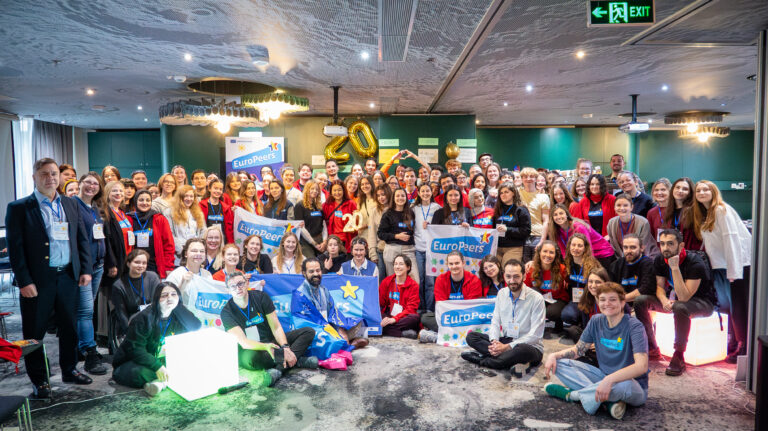
On 3 March 2026, the webinar EuroPeers at 20: Celebrating the Journey, Imagining the Future brought together EuroPeers, National Agency representatives, coordinators, and other colleagues connected to European youth programmes. The event was created as a moment to look back on the 20-year journey of the EuroPeers network, reflect on its meaning for young people and National Agencies, and open up a shared conversation about where the network could go next.
From the very beginning of the webinar, it was clear that EuroPeers is associated with much more than information-sharing alone. Participants described it through words such as friendship, community, family, opportunities, engagement, and impact. These first reflections already pointed to something essential: EuroPeers is not only a network built around mobility and volunteering experiences, but also a space of connection, belonging, and peer support that continues to grow across countries and generations.
Looking back: the story of EuroPeers
The first part of the webinar offered a brief journey through the history of EuroPeers, presented by webinar host Elisabeth Purga. The story showed that although EuroPeers officially traces its beginnings to 2005–2006, the roots of the network go further back — to earlier European youth programmes and to the growing desire of young people to share their experiences with others.
A key turning point came when the peer-to-peer approach was tested during European Youth Week in Germany. Instead of relying only on institutional communication, young people themselves became the ones reaching out to other young people. The result was both practical and powerful: the message became more relatable, more credible, and more inspiring. From there, the EuroPeers idea began to develop further.
The webinar highlighted several important milestones in this development: the official birth of the alumni network, the gradual spread of the idea to other countries, the establishment of the international network in 2014, and the strengthening of a shared structure in the years that followed. Since 2015, annual international meetings have created space for EuroPeers and coordinators from different countries to come together, exchange practices, and build a stronger common identity. More recently, the long-term activity has brought additional structure and continuity to the network’s international cooperation.
Looking back at this timeline made one thing especially visible: EuroPeers has grown from a successful peer-to-peer idea into a European-level network with a clear identity, while still keeping its original spirit at the centre.
Spotlight from the network: youth experiences and personal journeys
The second part of the webinar was dedicated to two personal stories from within the network, shared by Alexandra Person and Septimiu Simion. Their contributions showed in a very concrete way what EuroPeers can offer to young people — not only in terms of activities, but in terms of confidence, belonging, growth, and direction in life.
Alexandra Person reflected on a journey that started with her own international experience and gradually developed into long-term involvement in EuroPeers in both the UK and Germany. She described how being part of the network shaped not only her professional path, but also her friendships, values, and sense of purpose. Through EuroPeers, she moved from participating to taking on active roles such as junior and senior trainer, while also becoming involved in wider youth work and project coordination. Her story highlighted how EuroPeers can open doors step by step, offering young people space to grow, take responsibility, and discover new possibilities for themselves.
At the same time, Alexandra also looked towards the future of the network. She stressed the importance of making EuroPeers even more accessible and inclusive, especially for young people with fewer opportunities. In her view, this means reaching out more intentionally to local organisations, youth clubs, schools, and communities, and ensuring that new members feel represented, welcomed, and able to belong from the start.
Septimiu Simion shared a different, but equally powerful journey. He spoke about discovering European opportunities at a moment in life when he was looking for direction, and how a volunteering experience abroad became the beginning of something much bigger. After returning home, he found EuroPeers Romania and quickly became an active part of the network. Through trainings, public speaking, storytelling, and outreach to schools and communities, he developed both personally and professionally. Later, this path also led him into a role within the Romanian National Agency.
His story captured another important dimension of EuroPeers: the network not only helps young people reflect on what they have gained, but also gives them a way to give back. For him, EuroPeers became a way of staying connected to a community of shared values, while also helping others discover opportunities that can change lives. His contribution strongly underlined the idea that solidarity, in the context of EuroPeers, is something to be lived in practice.
Together, these two stories gave a human face to the network’s impact. They showed that EuroPeers is not only about promoting programmes, but about long-term transformation — of confidence, skills, careers, and communities.
The value of EuroPeers for National Agencies and the European context
The third part of the webinar brought together Natalja Klimenkova (Estonian network coordinator), Simona Musteata (Romanian network coordinator), and Bente Wester (Netherlands network coordinator) for a panel discussion on the value of EuroPeers for National Agencies and for Europe more broadly. Their perspectives made visible how the network matters not only for individual young people, but also for institutions and for the wider European youth field.
Each of the panelists brought a slightly different starting point. Natalja Klimenkova connected her current role in Estonia with a much longer journey in youth work and youth participation. Simona Musteata reflected on the process of building the Romanian network from 2020 onwards, during a particularly challenging pandemic period. Bente Wester shared her own transition from being an active EuroPeer in the Netherlands to becoming a national coordinator. Together, their stories showed that EuroPeers is built through both professional commitment and personal belief in young people’s capacity to lead.
A strong theme throughout the panel was that EuroPeers makes opportunities more visible and more believable. Young people often trust other young people most, especially when hearing directly about an experience such as a youth exchange, volunteering project, or mobility opportunity. From this perspective, EuroPeers does not replace the work of National Agencies — it extends it. It helps reach young people in places, communities, and contexts that formal institutional communication alone may not reach so effectively.
The panelists also emphasized that the network brings valuable youth perspectives into the work of National Agencies. Through EuroPeers, agencies can stay closer to the realities, language, motivations, and needs of young people themselves. This makes communication stronger, outreach more relevant, and activities more grounded in lived experience.
At the same time, the discussion highlighted the importance of the international dimension. EuroPeers is not only a collection of national networks; it is also a European community. This cross-border layer gives young people the chance to stay connected even when they move between countries, while also creating motivation, shared learning, and a sense of common mission. The panelists described this international dimension as something both practical and deeply meaningful: a place where national identities and European identity meet, where friendships continue across borders, and where young people know they are part of something bigger than themselves.
Looking ahead: a future built by people
The final thematic input of the webinar was shared by Kai-Ines Nelson (EuroPeers International network coordinator), who offered a future-oriented perspective on EuroPeers as an international network. Her contribution placed strong emphasis on continuity, cooperation, and belief in young people.
She described EuroPeers as a network that helps European values become visible through action – not through abstract statements, but through stories, support, engagement, and peer-to-peer encouragement. In her perspective, the future of EuroPeers depends on continuing to strengthen cooperation across countries, making the network feel welcoming in every national context, and ensuring that young people have both the trust and the space to lead.
Her reflections also pointed towards a future in which the network continues to grow. She welcomed the interest of Croatia as a potential new country in the network and also referred to hopes linked to the UK’s future return to Erasmus+. These examples reflected a wider sense that EuroPeers still has room to expand and connect with even more young people.
Most importantly, her message was that the next chapter of EuroPeers will not be shaped only by structures, but by people: by those who keep telling stories, building bridges, and opening doors for others. In that sense, EuroPeers was described not simply as a project, but as a legacy in the making.
Conclusion
The closing reflections from participants made clear that the future of EuroPeers is imagined in bold and generous ways. Among the hopes shared were a wider international reach, more cooperation between EuroPeers from different countries, stronger visibility, and even more opportunities for young people to tell their own stories. Some participants imagined a network that grows beyond current borders; others highlighted the wish that every young person could access volunteering, mobility, and active participation more easily. There was also a clear desire to see EuroPeers remain a positive, youth-led force in a time when such spaces matter greatly.
Taken together, the webinar showed that after 20 years, EuroPeers remains rooted in the same powerful principle with which it began: young people reach other young people best. What has changed is the scale, the strength, and the depth of the network that has grown around that principle. EuroPeers today is not only a peer-to-peer initiative, but a European community shaped by shared experiences, friendship, learning, and action.
The webinar was therefore not only a look back at what EuroPeers has achieved so far. It was also a reminder that its future is still being written — by the young people, coordinators, and partners who continue to believe in the value of sharing experience from one young person to another.e is still being written — by the young people, coordinators, and
partners who continue to believe in the value of sharing experience from one young person to
another.